





David Vann: „Scrisul m-a eliberat” (partea I)
Scris de Mihaela Butnaru • 30 October 2013 • in categoria Interviuri
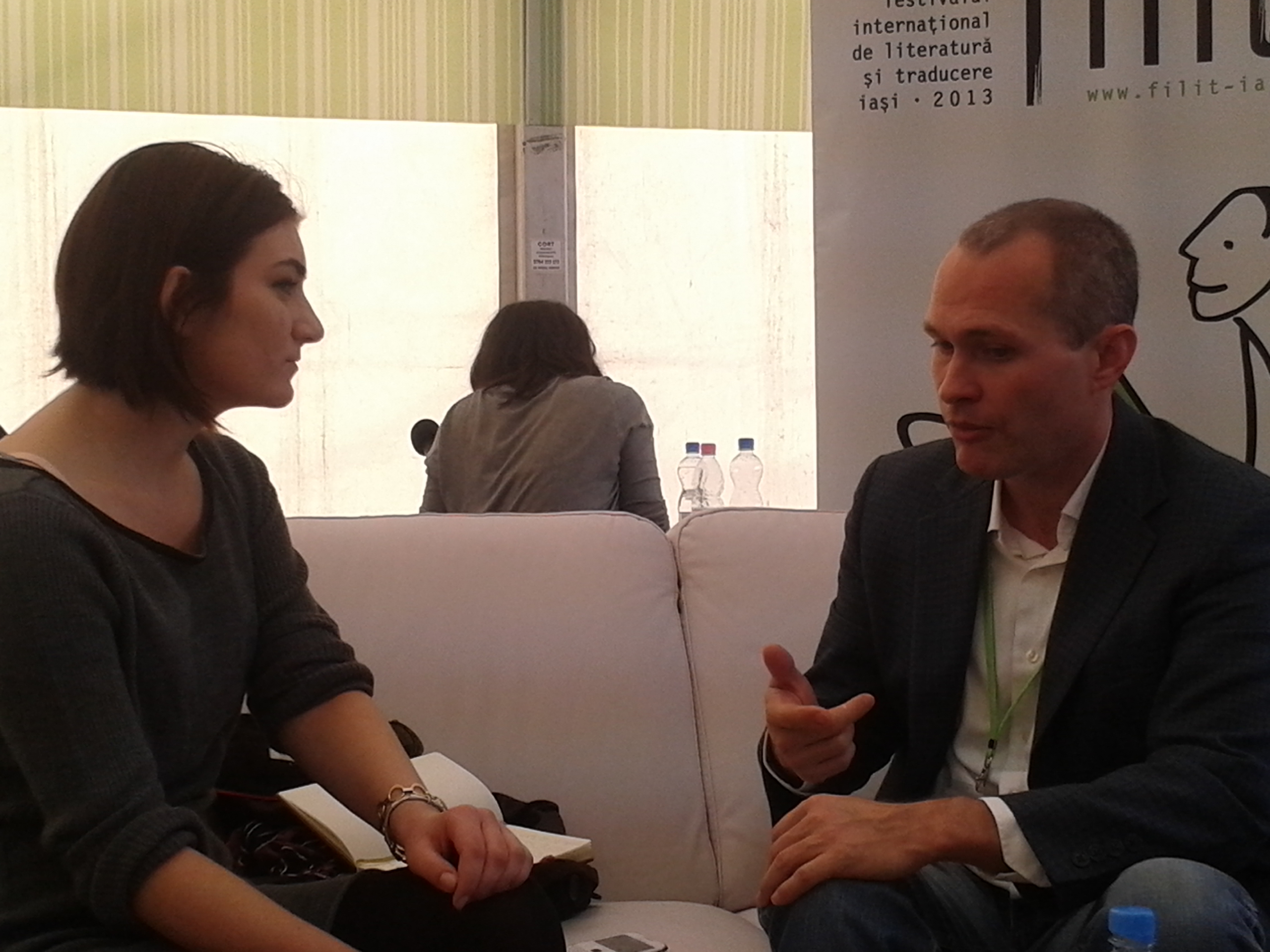 L-am întîlnit pe David Vann la FILIT Iaşi, în două sesiuni de discuţii fascinante despre gîndire pozitivă, destin şi literatură. În volumul de povestiri tradus în româneşte - Legenda unei sinucideri -, David Vann tratează subiectul sinuciderii tatălui său. Cartea, o lectură dificilă din punct de vedere emoţional, nu m-a pregătit în nici un fel pentru persoana volubilă, deschisă şi generoasă pe care am întîlnit-o. Prima discuţie cu autorul a fost pe cît de provocatoare, pe atît de scurtă, astfel că, cu ajutorul traducătoarei Justina Bandol, am continuat conversaţia cu David Vann după închiderea programului festivalului. Astăzi, vă ofer prima parte dintr-o întîlnire intelectuală foarte plăcută, urmînd să vă povestesc despre scris, traducere şi recunoştinţă într-un episod viitor.
[english version below]
Mihaela Butnaru: Încep prin a vă ruga să împărtăşiţi cîteva lucruri despre dumneavoastră cititorilor bookblog.ro.
David Vann: Provin din Alaska, am copilărit într-o pădure din insulele Aleutine, unde există lupi şi urşi şi tot timpul am avut senzaţia că sunt urmărit, poate chiar vînat. Copacii căzuţi formau un fel de al doilea nivel sub care, copil fiind, aş fi putut oricînd cădea. Insula reprezintă în continuare un loc mitic, misterios în imaginaţia mea. Nuvela „Sukkwan Island” din Legenda unei sinucideri este plasată la 50 de mile de Ketchikan, unde am copilărit eu, într-o pădure asemănătoare, şi are ca subiect sinuciderea tatălui meu. De fapt, el chiar m-a rugat să vin să petrec un an cu el în Alaska – părinţii mei fiind divorţaţi – şi am spus că nu. S-a sinucis la scurt timp după aceea, iar eu m-am simţit foarte vinovat, fiindcă poate dacă aş fi spus că vin, tatăl meu ar trăi încă. Scrierea acestei nuvele, în care un băiat şi tatăl lui petrec un an întreg în Alaska este în mod clar o a doua şansă, cea de a spune da şi de a petrece un an cu tatăl meu, chiar dacă atunci cînd am scris-o, nu m-am gîndit la asta. Scrisul a fost mereu pentru mine ceva inconştient, niciodată nu îmi dau seama ce fac, nu am un plan sau o conturare a ceea ce vreau să fac, nici măcar nu ştiu despre ce va fi cartea, îmi dau seama pe parcurs. Cărţile mele arată la publicare aproape la fel ca prima ciornă. Mai aranjez frazele, dar nu tai sau adaug scene, deci cartea reprezintă o viziune inconştientă unitară. Pentru aceasta [Legenda unei sinucideri], am încercat să scriu despre sinuciderea tatălui meu, un eveniment tulburător, şi nu am avut o singură poveste despre el, o singură modalitate de a mă împăca cu situaţia, prin urmare am scris şase poveşti care se reflectă în diferite feluri. Există între ele o dezbatere de stil şi conţinut, iar împreună formează un portret mai haotic, dar mai complet al sentimentelor contradictorii provocate de sinuciderea tatălui meu.
M.B.: V-a ajutat această carte să treceţi peste perioada dificilă care a urmat sinuciderii tatălui dumneavoastră?
D.V.: Cred că scrisul este terapeutic, mă simt mai bine după ce am scris patru cărţi care au ca subiect familia mea. Cea mai recentă se numeşte Goat Mountain, am simţit ca şi cum mi-aş pune familia pe rug...o familie cu 5 sinucideri. Uneori cred că este amuzant, dar asta e, e o situaţie în care plîngi sau rîzi. Bineînţeles că la început este foarte epuizant, este o moştenire lăsată de sinucidere. În fiecare ţară unde am fost pentru turnee, şi sunt peste 20, toţi împărtăşim aceeaşi moştenire, care înseamnă mai ales ruşine. Timp de trei ani am spus tuturor că tatăl meu a murit de cancer, fiindcă altfel m-aş fi simţit murdărit, sinuciderea lui a fost foarte violentă. Am fost şi foarte furios pe el, am simţit furie timp de 30 de ani. M-am simţit şi foarte vinovat, pentru că refuzasem să petrec acel an cu el, toţi din familie se simt vinovaţi, ceea ce este nedrept, nu e vina nici unui membru al familiei într-o sinucidere, dar toţi se simt ca şi cum ar fi. M-am simţit de asemenea sortit să-i repet destinul, timp de 20 de ani am simţit că sinuciderea mă aşteaptă, că voi atinge un prag în viaţa mea cînd va fi imposibil să-i rezist.
M.B.: Am citit că aţi avut un moment pe vasul cu care aţi pierdut tot ce aveaţi, un moment ca o epifanie, în care v-aţi dat seama că nu e nici un motiv să vă sinucideţi.
D.V.: Da, v-aţi informat corect...este ciudat, un moment teribil s-a transformat într-unul minunat în care mi-am dat seama că sunt liber de moştenirea lăsată de tatăl meu. De fapt, cele mai rele lucruri din viaţa mea au devenit cele mai bune. Mi-am dat seama că viaţa a avut mereu o a doua şansă pentru mine, m-am simţit mîntuit. Poate are legătură şi cu faptul că fiind american, vorbitor de engleză, din clasa de mijloc şi cu o educaţie bună, mi-este mai uşor să-mi revin, deci am avut cîteva avantaje. Este groaznic să treci printr-o tragedie, indiferent care este fundalul pe care se desfăşoară, dar dacă reuşim să trecem prin ea, ne dăm seama că apoi ne putem bucura de viaţă mai mult, că poate avem o mai mare libertate. Un aspect minunat al faptului că provin dintr-o familie distrusă, despre care nu pot spune în nici un fel că este ok, este că nu trebuie să mă prefac. Este o eliberare teribilă să nu te mai prefaci. Mulţi oameni trebuie să-şi păstreze o imagine că lucrurile ar sta bine, chiar dacă există ceva tensiune, însă familia mea era atît de distrusă încît acest lucru mi-a dat o mulţime de opţiuni. Mi-a oferit o libertate teribilă, pe care acum o apreciez. Şi tatăl meu mi-a oferit libertate. A scris un bilet cînd era aproape de sfîrşit, în care spunea că banii nu contează şi că ar trebui să fac ce îmi doresc. A fost o libertate oferită din mormînt într-un fel, pentru că apoi m-am gîndit că poate viaţa nu înseamnă să faci bani şi că mai bine aş face ceva ce mă pasionează cu adevărat. El mi-a oferit o libertate pe care el însuşi nu a avut-o. A făcut parte dintr-o generaţie cu mai multe constrîngeri, în care trebuia să munceşti pentru a-ţi întreţine soţia şi copiii, să fii un anume tip de bărbat. El nu şi-a dorit să fie aşa şi asta a contribuit la sinuciderea lui. Eu sunt mult mai norocos decât a fost el. Sinuciderile sunt tragice, dar ne şi dăruiesc ceva, iar aceasta este partea surprinzătoare.
M.B.: Consideraţi că scrisul v-a oferit libertate?
D.V.: În scris am libertate totală, se poate întîmpla orice pe foaie...în ultima mea carte, băiatul ucide pe cineva, un cerb devine fantomă şi bunicul se transformă într-un Dumnezeu, apărînd o Sfîntă Treime în esenţă. Aceasta este o libertate scandaloasă pe care nimeni nu şi-ar lua-o în realitate, dar în ficţiune pot face orice. În romanul Dirt băiatul îşi îngroapă mama de vie, o libertate pe care nu mi-aş lua-o în viaţa reală. În ficţiune însă, orice este posibil şi asta face totul extrem de interesant.
M.B.: Seamănă cu inconştientul psihanalitic...
D.V.: Aşa este, dar scrisul este de fapt mult mai liber decît terapia, pentru că în scris poţi ajunge oriunde fără să fie necesar să ai o legătură cu realitatea, fără să iei decizii care ţin de realitate. Eşti mai liber decît într-o terapie. Eu am fost cu mama mea la terapie, încercam să ne înţelegem mai bine şi a trebuit să luăm nişte decizii reale ca să se poată întîmpla asta, deci nu eram în totalitate liberi. Trebuia să fim grijulii unul cu celălalt, şi chiar cînd am fost singur în terapie, încercînd să vorbesc despre sinuciderea tatălui meu, trebuia să iau nişte decizii referitoare la viaţa mea. Dar ficţiunea este ca un tărîm liber, unde lucrurile pot lua o turnură nefericită şi totul ajunge la extrem, însă este bine aşa, este în regulă...
M.B.: Şi cititorilor li se pare mai interesant cu cît o carte devine mai extremă şi mai excentrică...
D.V.: Păi am promis că scrierile mele vor fi explozive, chiar sunt, se întîmplă lucruri nebuneşti şi totul este împins foarte departe din punct de vedere psihologic.
M.B.: Psihologic, Legenda unei sinucideri este construită în jurul traumei emoţionale. Care este părerea dumneavoastră despre emoţii şi ataşament?
D.V.: Una din moştenirile lăsate de o sinucidere este teama de abandon. Pentru că cineva iubit a dispărut brusc, una din temerile mele de fiecare dată cînd mă îndrăgosteam sau îmi păsa de cineva, era că o să plece pur şi simplu. Teama aceasta m-a făcut să nu mă descurc în relaţii. În timp, lucrurile s-au îmbunătăţit, iar scrisul m-a ajutat şi el. Cred că sensul vieţii este dat de ataşamentul faţă de alţi oameni, avem nevoie să stabilim relaţii apropiate cu ceilalţi. Mai cred că scrisul ne poate ajuta să vedem cît de buni sau răi suntem în aceste relaţii, să devenim mai receptivi şi mai realişti faţă de ceilalţi.
M.B.: Ce carte de aceeaşi intensitate cu cele scrise de dumneavoastră ne-aţi recomanda?
D.V.: Este vorba despre Cormac McCarthy, cu Blood Meridian, în care sud-vestul american este văzut ca un infern, dar un peisaj atît de frumos. Este o carte foarte violentă, dar şi frumoasă pînă la ultima propoziţie. Nu se ocupă foarte mult de personaje, deci nu este ca majoritatea cărţilor, dar peisajul şi perspectiva creează această viziune superioară, ambiţioasă asupra literaturii, care o face să fie o carte foarte frumoasă. Este cartea care-mi place şi pe care o recomand. Dacă din toată literatura americană ar fi să citiţi o singură carte, atunci recomand să fie Blood Meridian, este o carte greu de citit, dar foarte frumoasă.
David Vann este prozator american publicat în 19 limbi, cîştigător a 15 premii literare. În limba română, a apărut volumul de povestiri Legenda unei sinucideri, la editura Litera, în traducerea Justinei Bandol.
________
David Vann: Writing set me free (1)
Meeting David Vann during the first FILIT edition in Iassy was a great opportunity to learn something more about positive thinking against all odds. His first book translated in Romanian, Legend of a Suicide, deals with his father's suicide. The book, an emotionally challenging reading, hadn't prepared me for the positive, warm and generous person I was about to meet. Our first interview was as short as it was provocative, so with a little help from Justina Bandol, the translator of the book, we continued the conversation after hours. Below are a few of David Vann's thoughts on literature, life and fate. More about writing, translation and gratitude in the next part.
Mihaela Butnaru: Please tell me a few things about yourself that you would like to share with our readers.
David Vann: I come from Alaska, I grew up in a forest on Aleutian Islands, where wolves and bears lived and it felt like I was being watched, maybe even hunted. The trees would form a second floor that as a kid I could have literally fallen through. In my imagination that is still a mythical, mysterious place. The novella Sukkwan Island from Legend of a Suicide is set 50 miles away from Ketchikan, where I grew up, in that kind of forest, and it is about my father's suicide in that background. He actually asked me to come and spend a year with him in Alaska – my parents were divorced – and I said no. He killed himself soon afterwards and I felt very guilty, thinking that if I said yes, maybe my father would still be alive. In writing that short novel about a boy and his father spending a whole year home staying in Alaska it was obviously a second chance to go back and say yes, to spend that year with my father, even though I didn't realize that when I was writing. Writing has always been very unconscious for me, I never really know what am I doing, I don't have a plan or an outline or any idea what the book would be about, I discover this on the way. The books are published the same as the first draft. I fix sentences but I don't cut scenes or add scenes so it's just one unconscious vision. For this one I was trying to write about my father's suicide, which is obviously a very upsetting event and I didn't have one single story to tell about him, I didn't have one way of coming to terms of it, so the book is in six pieces that reflect in different ways. They have a kind of debate in style and content and together they form a messier, more complete portrait of kind of conflicting feelings about my father's suicide.
M.B.: Did this book help you get through the difficult time after your father's suicide?
D.V.: I think writing was therapeutic, I feel a lot better after writing four books that have my family in the background. The most recent is called Goat Mountain, so those four books together, it was like making a kind of bonfire out of my family, a family with 5 suicides...sometimes I find it funny, but it really is like you cry or laugh. Of course in the beginning it is very debilitating, there's a legacy afterwards, in every country I go, and there are more than twenty countries for book tours, everyone has the same legacy where you feel shame. For three years I told everyone that my father had died of cancer, I couldn't admit it was suicide, because it would have made me dirty, it was violent and I was really angry at him, it was just rage for 30 years. I felt very guilty because I said no to spending an year with him, everyone in the family had some cause for guilt and this is unfair, it is really none of the family's fault, but everyone feels that it is. And I also felt doomed to repeat his suicide, for almost 20 years I felt that suicide was waiting for me, that I'd hit a low point somewhere in my life and it would be irresistible to commit it.
M.B.: I read that you had a moment on that boat where you lost everything and it was like having an epiphany: There is no reason for me to commit suicide!
D.V.: Yes, you've done your research...It is funny, it was that terrible moment that become a wonderful moment, because I realized I was free of that legacy. Actually all the worst things in my life became the best things. I found life had always second chances for me, it felt very redemptive. I realized, partially because I am American, English speaking, middle-class and have a good education, it is easier to bounce back after things, so I had advantages in life. You would think it is something awful when you experience some kind of tragedy, no matter what our backgrounds are, but if we get through that, often we have a fuller sense of enjoyment in our life and maybe more freedom. The wonderful thing about coming from a broken family that I can't possibly pretend it was OK in any way, it is that you don't have to pretend anymore. It is really a great freedom to not have to pretend. Most people have to keep up a front a little bit, that things are alright even if there is some tension, but my family is so hopelessly broken that I had a lot of options. It gave me tremendous freedom, actually, which I really appreciate. My father's suicide...he actually gave me freedom in some way, he wrote a note to me toward the end, that said that money didn't matter and I could do whatever I wanted. That was great freedom from the grave basically, because it made me feel that maybe my life shouldn't be about making money, maybe I should do something I care about. He gave me a great freedom that he never had himself in his life. He came from a generation that was more constrained, you had to support your wife and kids, get a job and be a certain kind of man. That wasn't really what he liked or wanted to do and that was part of his suicide. So I've been much luckier than he has been. The suicides are all tragic, but they offer gifts also. That is the surprising part of it.
M.B.: Do you consider that writing about it also gave you some kind of freedom?
D.V.: Yes, in writing I take absolute freedom, anything can happen on the page...In my last book, the boy kills someone who becomes some kind of Jesus figure, the buck becomes a ghost, the grandfather becomes some sort of God and essentially they form a Holy Trinity. That is the kind of outrageous freedom that no one would be able to take in their real life obviously, but in my fiction I could do anything. In Dirt the boy buries his mother alive, it's a freedom I can't take in real life. Anything can happen in fiction and that makes it very exciting.
M.B.: It looks very much like the psychoanalytic unconscious...
D.V.: Writing is actually more free than therapy, because in fiction you can go anywhere and you are not trying to relate back to your real life and making decision about what you'll do in your real life. You actually have a greater freedom than in therapy. I went a year in therapy with my mother, we were trying to get along better and we had to make some decisions about our real life trying to make that happen, so we weren't completely free actually. We had to be careful with each other and even when I went to therapy alone, talking about my father, it was still making decisions about my real life. But fiction is this kind of demon land that is entirely free, where anything can go terribly wrong and become extreme and it'a all safe, it's fine...
M.B.: And of course readers find it interesting, the more extreme and crazier a book goes...
D.V.: Well, I promised the books were explosive, they truly are, crazy things happen and everything goes very far psychologically.
M.B.: Psychologically, Legend of a suicide is built around emotional trauma. How do you feel about emotions and attachment?
D.V.: One part of the legacy of a suicide is the fear of being abandoned. Because someone I loved disappeared suddenly, so there's a fear in relationships that anyone that I fell for or that I cared for would just leave. That made me very bad in relationships, it made me screw things up. Over time that got better and writing helped as well. I think that meaning in our life is due to attachment to other people, I think we need close relationships to other people. Writing makes us think about how good and bad we are in relationships and I think literature actually helps us to be more realistic in our relationships, to be more responsive and make things works between us and other people.
M.B: What writer or book of the same intensity as yours would you recommend us to read?
D.V.: It is Cormac McCarthy with Blood Meridian, it is the American South-West as an inferno and it is such beautiful landscape. It is a very violent book, but very beautiful in every sentence. It doesn't care about the characters so much so it doesn't do what most books do, but the landscape and the vision on landscape create this really ambitious higher view on literature that makes it such a beautiful book, every sentence of it. That is the one I love most and recommend. Of all American literature if you have to read just one book, I recommend Blood Meridian, it is very difficult to read, but the most beautiful.
Citeste cele 2 COMENTARII si spune-ti parerea!
-
-
Mihaela Butnaru spune:
Mulţumesc, Andrei!
-

Andrei Rosca spune:
31 October 2013 | 8:34 am
Felicitari, Mihaela! :)