





Antti Tuomainen on taking Lawrence Block’s advice: Write what you want and don’t expect anything
Scris de Calina Matei • 13 January 2014 • in categoria Interviuri
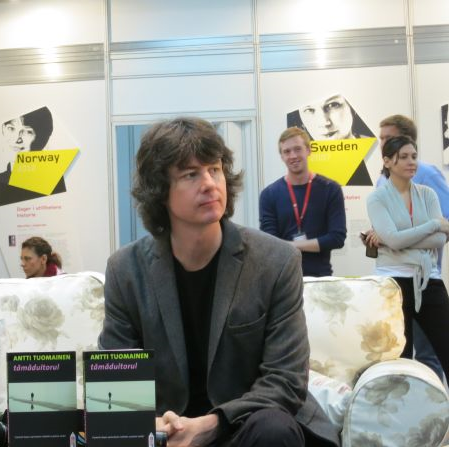
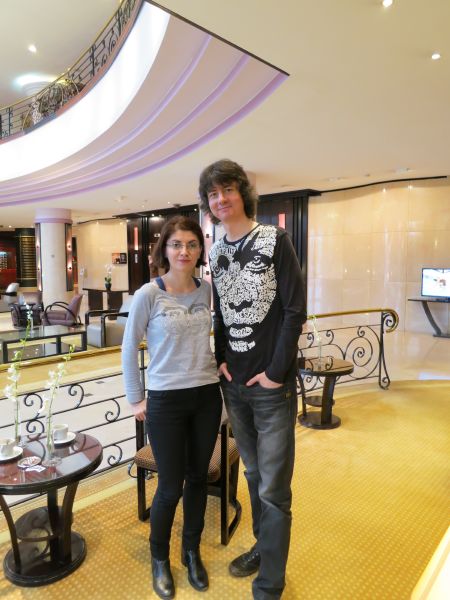
One of the first things I noticed about Antti Tuomainen, while he came out to the lobby, was his stature. He is a tall, lean man with an ever-present subtle smile on his face. And even when his lips aren’t smiling his eyes are. Unlike many misconceptions I may have had about people from Finland being cold he was very warm and funny throughout the interview. But probably what I’ll remember most about him (aside from all the thank you’s and the undisguised honesty of his answers) will be his resemblance to Neil Gaiman. I blame it on the hair!
Călina Matei:If you could go back now to your room and sleep or do whatever instead of this interview which character from your book would you send back in your place?
Antti Tuomainen:Good question! I would probably either send the main protagonist, the main character in The Healer Tapani but for some reason I started to think it would be interesting if Johanna showed up. Because we don’t see her or we see her and we hear from her but it would be nice to hear what a journalist would do in this case. So I would probably choose Johanna.
The Healer tells the story of a man searching for his missing journalist wife, that disappeared a few days before Christmas while investigating a string of environmentally related murders. His investigation brings him in the face of danger but his determination to find the love of his life makes him stop at nothing. For the review click here.
CM: I enjoyed the book. I enjoyed reading it and it kept you in there somehow even though the subject is a bit dark. It’s always raining, it’s always dark, and the Apocalypse is coming.
AT: It’s a dystopian story. It happens in a dystopian environment that’s true but in the end I don’t see it as being just a very dark story. I think it’s also a story that has this sort of hope or warmth to it because it’s a crime story and it’s a love story.
CM: How did you come up with the idea of setting the story against the backdrop of the world almost ending, with all those environmental disasters, the plague and Ebola and other similar things?
AT: All my books, (he’s written four books so far and is in the course of writing a new one) have been a combination of different elements. For a crime novel that is a bit different, like the one where talking about here, is one of the things I started out with. I wanted to tell a story that would be a crime story and I wanted to combine it with a love story and I also wanted to set it in an environment that is of course imagination because we don’t know the future. But that was one of the things I got interested in maybe 10 years ago in this, what we call climate change and I read a lot about it. I read many books, I read many articles and I thought it was very interesting what the scientists were predicting but at the same time I was thinking that it was a bit abstract, it’s a bit scientific so I started to think what would it look like, what would it mean for a city like Helsinki which I write about. It’s a city I know very well, I’ve lived there for 32 years so I know it very well.
CM: You can feel it in the book, the street corners and you get to see it in your mind so that has to come from someone that actually knows what they’re talking about and you can feel the pulse of the city and its vibe.
AT: Helsinki is an important character in all my books and I started to think what would this Helsinki that I know so well look like if it was the same city that it is today but slightly changed because that’s what it is, it’s not science fiction city, it’s Helsinki as we know it but slightly changed so I wanted to bring that setting as something that is a given, something that is for the reader to read not for the reader to hear me explaining. 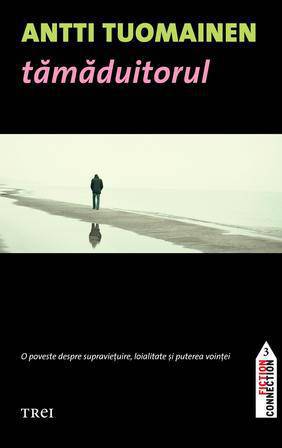
CM: When I was doing research for this interview I noticed that before you started writing you were a copywriter and you own awards for that. How did you cross over from that into becoming a novelist? Did it bore you or bother you the commercial aspect of being a copywriter or you wanted to do something more elaborate or satisfy maybe a need inside of you?
AT: I think you’re on the right track there but first of all I must say I was a writer before I became a copywriter. I was maybe 18 or 19 when I knew I was going to be a writer someday so from then on I’ve been writing. Of course there was this need to make a living so there’s this question of making a living by writing and in order to make a living by writing you have to be prepared to write all kinds of things and Finland has a population of 5 million, so if you’re going to make a living writing in the Finnish language you have to be prepared to write anything you can write in the Finnish language. So I have written in the 23 years that I’ve been writing and earning my place in the world with that, I’ve been writing basically anything you can write, I’ve been writing anything from advertising to screenplays, from playwriting to books from radio to television from internet to anything.
CM: So you’re a Jack of all trades in the area of writing?
AT: Well it probably could seem that way but really I write novels, that’s what I do best and it’s what I want to do. But along the way I wrote a lot of things and I wrote my first two novels while I was still working as a copywriter. I was fired from my last copywriting job from an agency in 2009 and it was the best thing that has happened to me in my professional copywriting career. Getting fired was ultimately the best thing because I’ve been doing it for 13 years and in 13 years you can pretty much do everything you want to do in advertising and I had been doing for so long that when I first started out I was an ambitious young man writing advertising and was suddenly very good at it and I got great jobs but when your heart is in writing books you realize that after a while you can’t go on doing something where your heart’s not there. My heart wasn’t in advertising at all, I did it for a living and finally when I got fired I was so grateful for this so I decided to become a full time writer. It was one of those decisions where I thought that I would rather be poor and write novels.
CM: What made you go with this genre of crime and noir?
AT: Well since you’ve read one of my books you’ve seen that it’s not a traditional crime novel. And that’s true for all my novels; they are not traditional crime novels. What I find fascinating in the crime novel is the fact that I can use ingredients for crime novels to create a very dramatic story and that’s why I like the crime novel because it gives you this dramatic setup and situation for people to find themselves in and I can deal with subjects and themes that are important for me.And I tend to write about big eternal themes like love, death, honor, loyalty, friendship, the relations between mother and son, between father and son, between man and wife.
CM: The universal aspects of life that everyone can find and relate to.
AT: I like classical stories, the classical themes, the big themes and in a crime novel you can start a story where the character is in the most desperate situation of his life and from then on it gets worse until it gets a bit better. So it’s a very good narrative way of exploring these themes.
CM: How did the work you did as a copywriter help you with writing novels? Did it teach you anything in particular about how to sell a story and make it more appealing to your public and your readers?
AT: No, not really. But there is one thing. First of all of all it doesn’t work because even when I was a copywriter I was a writer at heart. I’m a novelist at heart. writing novels is the most important thing to me and I like to have the freedom to write whatever I wish to write so there are no considerations and I can’t think to myself or I couldn’t think to myself four years ago when I started writing Tămăduitorul I didn’t think that four years later I’d be in Bucharest talking to you about this novel that has been translated into Romanian. You can’t. You write the book you want to write and hope for the best. One of the best pieces of writing advice I heard is from Lawrence Block an American crime novelist is “write what you want and don’t expect anything”. I think it’s really good advice but the other thing I was going to say about advertising is one thing I learned and one good thing I learned is the deadline. If you’re supposed to have something ready by Tuesday at 2 o’clock you’ll have it ready by Tuesday at 2 o’clock because no matter how you feel or if the sun is up or down or it’s been a good day or a bad day your job is done Tuesday at 2. And when you do that for 13 years you start being very good at deadlines.
CM: You mentioned Lawrence Block and his advice, do you have any other crime or noir type of books that you really appreciate and consider an influence for what you do?
AT: Most of my influences are probably Finnish so you wouldn’t know anybody that I would mention because they haven’t been translated at all.
CM: Any other international ones?
AT: I was thinking that from early on I had this influence from American writers like Joyce Carol Oates, Cormac McCarthy,probably earlier a long time ago Ernest Hemingway, Raymond Chandler. All those old masters of their specific genres were very interesting at the time. But lately I don’t know, they are just too many.
CM: What is your process for writing? Do you have any ritual? You said you can write on a deadline but what if you have writer’s block or are just not in the mood. How do you find your way through that?
AT: I think it was Ernest Hemingway who wrote that when you’re absolutely desperate and you’re completely blocked you write one word because he said you just can’t write just one word. When you write one word you follow with another and pretty soon you have a sentence and another sentence and then word by word you start having something again because he said you can’t write just one word.
CM: How do you choose your subjects that you write about? Do you have a triage for ideas? Do you feel closer to a certain type of subject?
AT: As I’ve said I’m drawn to these classical themes of love and death and loyalty and friendship and of course family, family relationships, family secrets, family ties and all that is very important for us and can have so many meanings.
CM: But how do you know that one idea could become a novel and one idea couldn’t. Do you have a gut feeling or an idea and you build around it and think more and develop characters?
AT: It’s a funny process. I get a lot of ideas but most of them just pass but then there’s one idea that keeps coming back and you know when you’ve had it for a certain period of time and it keeps it is evolving and growing quite naturally and then you know that there’s something here that I need to write, that I need to see where it leads.
CM: As a personal curiosity about The Healer: out of all the jobs in the world that Tapani could have had why did you make him a poet?
AT: Two reasons. First of all I thought it would be really interesting to have a poet as main character, a narrator of a crime story. I never heard of such thing and hopefully the readers haven’t either. And the other thing just as important was that when you have a poet as a narrator for a story you have a poetic license, you can use language that is poetic.
CM: That was something beautiful about the book and there were certain passages that I kept re-reading because of that.
AT: Thank you! I worked very hard on that. And poetry is something that is very dear to me. It’s something that I’ve always read, that I’ve always admired. When you have a poet telling a story he can say anything.
CM: How did you know when to stop working on the phrase or the paragraph and keep it sounding effortless and not edited to death?
AT: Good question! (chuckles) I tend to work a lot on my text but there is a point when you just have to be ok, this needs to be this way. It’s something that you get better at all the time. The more you do it the more you know that this is how it should be. But it has been something to learn. I’ve been writing for 23 years and it’s one of the things that I’ve always worked very hard on my texts and it’s made me a slow writer. And I’ve also done journalism and when I worked on a story and for the editors it was painstaking because I was a perfectionist in my text. But you learn and in a way you see that this is how it should be.
CM: Are we going to see a sequel for The Healer since the ending was so abrupt?
AT: First of all about the ending I thought it was an ending that this particular book needed, it’s that kind of story that needed this kind of an ending. As for the question if there will be a sequel I really have no idea because I don’t really plan that much ahead. I write the book I want to write and it hasn’t come up yet. But I’m not saying that one day I won’t wake up and say „now I know”.
CM: I know that you’re writing your next novel. What will that be about?
AT: The Healer was my third book. I’ve now published my forth book that came out in Finland out in June. That is a story about a mother and a son. The mother goes missing in 1993 when the son is 13 years old. 20 years later in 2013 the son is sure that he knows who is behind this disappearance and it’s a story for the search of what happened to his mother in 1993 and it’s very much a story about their relationship and it’s a story about the need to know.