





Roslund & Hellström: Actually, it’s been a privilege to be part of a society debate as „just crime writers”. And it was not something we were expecting, but now we are in the middle of it and being respected for it. – Part I
Scris de Alice Teodorescu • 28 January 2014 • in categoria Interviuri
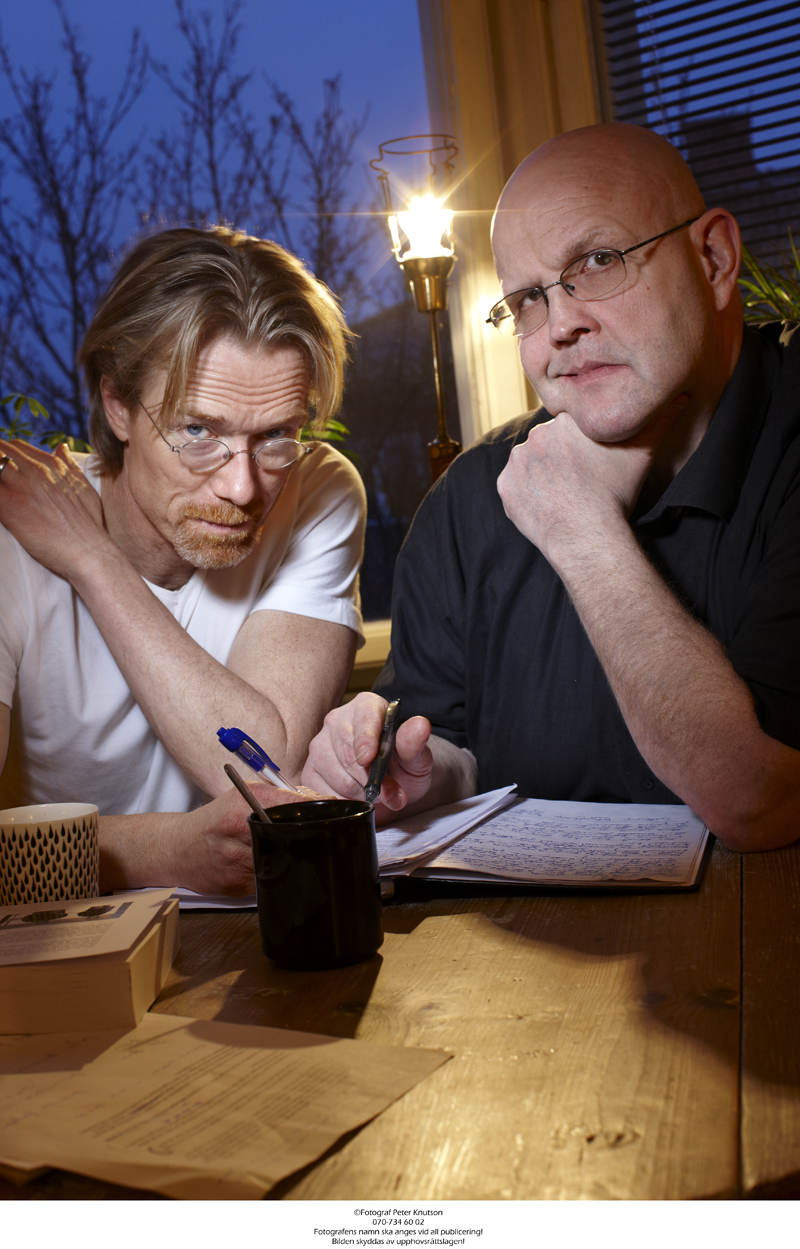
Meeting Anders Roslund and Börge Hellström was quite the experience. Being in Romania for the first time, as part of the invited countries’ authors at Gaudeamus, the highly acclaimed and award-winning Swedish crime duo, was sitting relaxed and smiling at a small table in their hotel’s café.
I didn’t know what to expect from these two “crime fiction” minds, but I knew I’m in for a bunch of surprises as they have a really interesting past, a past they use for the realism in their novels: Roslund as a 15 years news reporter and award-winning investigative journalist whose life was in danger a couple of times due to the subjects he tackled, and Hellström as a reformed ex-con and drug addict, being until present days youth counselor, parole officer and one of the founders of KRIS, a rehabilitation and crime-fighting organization in Sweden.
Well, it was way beyond what I first imagined, I must confess that. With water and coffee next to each other, music and various other noises around, we started a great conversation on writing, crime fiction, social criticism and the power of popular culture to change systems. I got a chance to peek into the mind of two amazing persons and now I invite you to read ahead and see how it all turned out:
Alice Teodorescu: How would you describe your writings, in one word or sentence? Because they have been described in so many ways, but I am curious about what you have to say.
Anders Roslund: Like a war.
Börge Hellström: No, that was our collaboration.
AR: This is a long sentence. The story is always number one, but if you can include a part of life that not so many people know about, then you have a wider story.
BH: I agree.
AR: Because our last book, not this one (Three seconds), is about 700 pages, so we need a lot of room.
AT: I am really fascinated and curious about the way you two write together. I’ve always felt intrigued about writing in pairs and was wondering how it works.
AR: The process first, because there is this myth that writing is the loneliest job on the planet, and yet we are not so alone, so we have a process that we divide into 3 stages. We didn’t know that for the first book, or the second book, but you evolve, you know? First we have one third pure research, since we made the rule to have 50% fact, 50% story. Because one can just tell stories, which is not better or worse, it’s just different. We thought that if we are here, we should have our own recipe and our combined knowledge on crime and crime preventing is more than that of other crime writers, so why not use it? So, at the start, we focus on who we really want to know, to meet, to talk to, whose trust we need and which key locations, key moments we need. And then we work very hard, because all the persons involved in our books, which are based on real people, are people not trusting anyone as we don’t either, for our reasons.
This book, Three seconds, took 2 years, no holidays included. It was 8 months of research, getting that trust, getting those stories, so we could build our fictional story. 8 months of sitting like this, and then, that’s the war thing, completing the story in details, as a long, long synopsis. Since we are two, we have to agree on everything. Now that they’re adapting our book, the filmmakers come back to us saying stuff like we never adapted a book having no logic faults, that’s a reward of being two, because we have the clear story from the beginning. And the last third is the writing, getting from the 150 pages to the 600 pages, to fill the characters with even more blood and the novel „stuff”, so to speak. That’s the recipe we have since then, a more structured recipe and that’s a choice, being two persons. But the war thing…
BH: It’s not that much war today, but a habit between us. We’re never arguing about the plot, the big story, the big things in the story, no problem, we always agree. It’s the details. Then we start to argue. We’re talking about Ewert, our superintendent, for instance, and saying: Why is he doing this?, what is he thinking at that moment? and how is he acting because of his thoughts? And then we start arguing. It’s not that much today, but we had a lot of arguing before, as none of us trusts other people. That is the basic feeling that I learned from my childhood and Anders learned from his childhood. But today we can make a choice to trust. In that case you also make the choice, you know, that you might be abandoned again. And that is what people are afraid of. Because if you don’t let people in, you don’t have to be afraid, yet if you let them in and trust them, you also make that other choice. Today it’s not a problem, but it has been.
AR: But it’s an interesting war sometimes, it’s not an interesting war when we go in the car to the library and can’t agree on the music to listen to or what to have for lunch. That’s just two boys being two boys. But with our superintendent…he’s never the main character, it’s always somebody else. So, in the first book it’s a father losing his child, in the second book, it’s the girl being taken advantage of her body… He’s always the second character. And when we talk about the small stuff, for example, Borge says He should shout now, he should be angry, he should have a loud voice, or I say No, it’s much more effective now if he whispers, because you shout and shout, nobody hears you… Then it’s an interesting conversation about human reactions or habits. Or maybe our own habits…And I have to say an interesting thing, Borge’s never wrong.
BH (laughing) : Yes, I am never wrong. Maybe I can think about things in the wrong way, but I am never wrong.
AR: So I have to say: Maybe you’re not wrong, but you’re not completely right. That’s the partnership! You learn to deal with each other, avoiding the war that you had in the first books, because you didn’t know each other that well.
AT: I believe that it is a good thing to know each other that well and be a bit vulnerable, for the writing process. But that leads me to my next question: how much of yourselves do you put in the characters and how does that work for you?
AR: That’s really interesting and it’s good to be two of us. First of all, when we put stuff in them, we deal with that in different ways. I live the characters, if I’m the abused child here, I live 24 hours a day four two years and Börge is so much wiser. He drops the feelings, the characters and the stories when he goes home. If both had been like me, it would’ve been a disaster. If both had been like Börge, it would’ve been a disaster as well.
But of course it’s about combined reactions of being abused, of being locked up if that’s what you need, or being in a joyful mood if that’s what you need. Maybe we have dilemmas for being two, but we also have an advantage when it comes to options, because I have seen a character being the same in different books, and we think it’s possible to avoid that.
AT: Well, I spent the last day and night reading Three seconds and it’s been amazing, because it felt authentic, it felt real. I think now you shared the „key”.
BH: We want to give people a piece of the world that they don’t know that much about.
AR: But we also have a problem with the research, because it’s a dilemma not to put everything on paper. You know so much and you want to show so much. But we are very keen that hopefully the story is still the story and after that you can talk about the reasons (like we did a lot on Scandinavian television, for example).
AT: Indeed. I feel, and I was wondering if you are doing it on purpose, that underneath the fiction and the entertainment part, there is a really strong social critique and there are lots of lessons to be learned, if you want to read between the lines.
BH: Thank you.
AR: We are really glad if you read that between the lines. If you choose a genre like crime novel, you expect maybe sometimes just 12 hours of reading and that’s it. But we managed to do a lot of good things, not to be bragging or anything. Our fourth book was about homeless people and we managed to change the budget for the first time, because the officials accepted the problem. After this book (Three Seconds) there was a big discussion on this issue that was not considered before (of the police using convicts and then abandoning them). And the next book, called Two soldiers, which is about gangs really - that has not been a problem in Sweden before, but now it’s a very big problem. Actually, it’s been a privilege to be part of a society debate as „just crime writers”. And it was not something we were expecting, but now we are in the middle of it and being respected for it.
BH: Exactly. I don’t think it’s that easy for the society to ask two crime novels’ authors to talk about these special problems. We are not the kind of experts that they want to have, but we are indeed experts of our own, in these specific topics. It’s great to become that way. I think we are good in describing the problem, because we can take it down to the human condition and explain to people: Hey, this is the way it looks. It’s a matter of people, not law or politics. People are suffering, people pay, and they are living human beings, don’t reduce them to some political decision! To me that is really important and I know it’s important to Anders, too.
AR: Of course, every author wants to be read as much as possible. Everything else is a lie. Sweden is a small country, it has 9 million people, but if 400.000 of them buy our book (and that was the case with Three Seconds), the percentage is so high, and they spent 12-15 hours with you and your thoughts, and even decide to read a few other books, then you get to them in a way that I couldn’t as a journalist, when I was making my super-documentaries, in my mind, because in an hour they were gone. But this is an active choice, you actually buy a book for something like 8 euros, and read it for a while. It’s, also, easier not to be pushed away with your facts if you hide your facts in the story and that was our decision from the beginning.
Credite foto: Peter Knutson